
She Shoots, She Saves: Kashmir Footballer Afshan Ashiq Chases Neymar and PSG Glory
Srinagar: For Afshan Ashiq, the most prized medal of her career didn’t come from a glittering podium or a winning goal-line save. It came in the form of an unexpected hug from her father, who had once disowned her for chasing a dream he couldn’t understand.
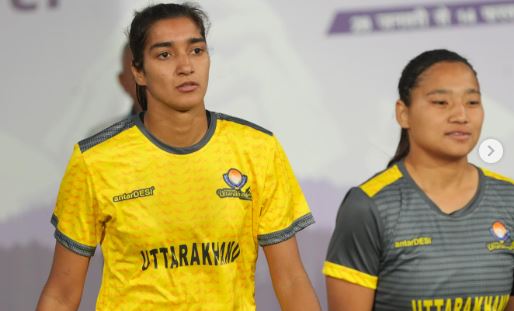
Today, the 30-year-old goalkeeper from Srinagar stands tall in her number 1 jersey, carrying the weight of many broken taboos and stitched-up scars, on and off the field. “That hug in Mumbai, after my first big match… that was more than a gold medal for me,” Afshan tells ETV Bharat, her voice quivering with quiet pride. “For the first time, my father saw me not as a rebel, but as a hardworking footballer.”
From Bemina in Srinagar to the broad turf dreams of Paris Saint-Germain (PSG), Afshan’s journey is both fierce and fragil–fierce in defiance, fragile in memory. Once a cricketer with little clarity on what future sport could hold for girls in the conflict-scarred valley, she turned to football by chance, after a coach, Abdullah Dar, spotted her sitting idle in the college ground. That brief encounter altered the arc of her life.
“At that time, girls weren’t playing football in Kashmir. Not really. And certainly not in public,” she says. “I trained in secret for a year because I was scared to tell my parents. Especially my father.”
But even in secrecy, football demanded its dues—bruised limbs, sweat-soaked jerseys worn under regular clothes for modesty, no changing rooms, and the steady drip of societal judgment.
“In those days, we’d wear jerseys under our clothes, even in summers. There was nowhere to change. Even getting to the field meant listening to taunts,” Afshan recalls. “People judge girls in Kashmir just by their clothes. But my religion gives me guidance—I follow that, and I follow my game.”
Her turning point came not with a victory, but with a fight to prove that girls, too, could fill stadiums with dreams. Starting her own football academy–Unique Football Girls–Afshan has since mentored over 200 girls. She earned her coaching credentials not out of passion for training but from the practical need to build a system for others, especially in a place where opportunities for female athletes remain painfully scarce.
“I always wanted to be a player, not a coach. But when there’s no structure, you create one,” she says. “We needed changing rooms. We needed respect. Waheed Ur Rehman Para (then J&K Sports Council Secretary) really helped us back in 2016. He gave us dignity.”
Her climb from Srinagar’s streets to India’s professional football circuit began when she joined Premier India Football Academy (PIFA) in Mumbai. That move marked the first time her parents saw her play—and the moment her father’s “No” finally turned into a tearful, proud “Yes.”
In 2019, she guarded the goalpost for FC Kolhapur City in the Indian Women’s League, squaring off with national stars like Bala Devi. “I’ve played with and against her a lot. She’s a striker, I’m a goalkeeper. Goalkeepers and Strikers keep tracking each other during the game,” Afshan laughs. “I’ve only conceded one goal against her—so far!”
Afshan’s list of club appearances spans nearly every state except Assam and Manipur, making her one of Kashmir’s most consistent and visible female footballers. But her ultimate goal is far from home: “My dream now is PSG. Neymar Jr. is my favourite, so…. People say that’s too big a dream—but then again, people said girls shouldn’t even play. I have always accomplished what people asserted that I won’t be able to”.
Growing up, she never imagined being a goalkeeper—her heart was set on midfield. But her coach, noting her height, build, agility and reflexes, pushed her between the posts. “I used to sneak out of the goalpost to the circle during practice,” she chuckles. “My coach would scold me so much. I thought being a goalkeeper was easy. Then I realized it’s one of the hardest, most thankless jobs. And also injury porn.”
Despite the isolation and stereotypes, Afshan never buckled. She trained with boys to toughen her game and invested her own money into travel, gear, and coaching—aware that most girls in the valley couldn’t afford to. She, now, does have sponsors.
“That’s what hurts. I got here, but I know many talented girls won’t because there’s no system, no local leagues, no support. Players from our region are better than people think. They’ve got stamina, heart, and skill. But they need platforms and support.”
As a Fit India Ambassador, Afshan now shoulders the responsibility of being a role model, often without having asked for the title. “My heart gets heavy when I think of my past,” she says quietly. “There were times I needed my family and they weren’t there. But I changed everything through sports. I want other girls to change their lives the same way. I smiled during my tough times and I continue to do that even today.”