
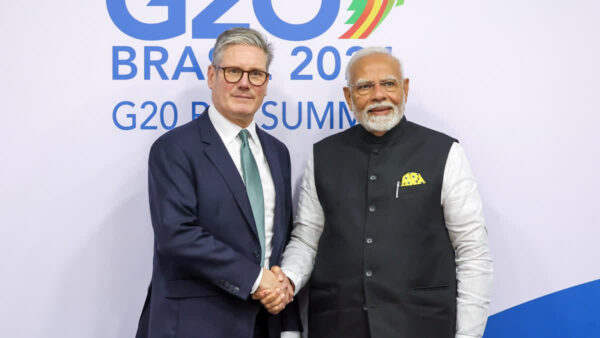
New Delhi: The recently concluded India–UK Comprehensive Economic and Trade Agreement (CETA) marks a key point in India’s evolving trade diplomacy and economic aspirations. After nearly three years of intense negotiations, the agreement has been finalised, possibly heralding a new chapter in bilateral cooperation between the two economies with deep historical, strategic, and commercial linkages. From India’s standpoint, the timing of this deal could not be more critical. As global trade realigns itself post-pandemic and amid rising geopolitical shifts, India’s move to secure preferential market access with key Western economies is a critical component of its broader economic and foreign policy strategy.
CETA takes a long-term view of the trade relationship and promises economic benefits for both countries, but especially for Indian exporters seeking access to high-value Western markets. Under the agreement, tariffs will be reduced or eliminated on a wide range of Indian exports to the UK. These include key labour-intensive and high-growth sectors such as textiles, footwear, carpets, automobiles, seafood, fresh fruits, medical devices, and whisky. In the short term, India will benefit from up to a 99 per cent reduction in tariffs on goods entering the UK market. For the UK, tariff elimination on high-end products such as Scotch whisky and luxury automobiles will make British goods more competitive in the Indian market, home to a rapidly growing middle class. Beyond tariffs, the deal includes streamlined customs procedures and trade facilitation measures, which are expected to reduce regulatory friction and improve ease of doing business for exporters on both sides.
The agreement is being touted as a jobs- and investment-boosting measure across several UK regions. Approximately £6 million in new investments are anticipated to flow into local industries as a direct result of the agreement. Northern Ireland, for instance, is expected to see gains worth £50 million across industries such as engineering, whisky production, technology, and services. About 150 Northern Irish companies are currently engaged in exporting to India, and the deal is likely to significantly scale up this number. Similarly, Wales is projected to see economic benefits amounting to nearly £80 million, particularly in sectors like manufacturing and clean energy. The deal also aligns with Prime Minister Keir Starmer’s “Plan for Change,” reflecting Labour’s intent to re-anchor the UK’s economic strategy through equitable and growth-oriented trade partnerships. The agreement is designed not only to reinforce economic ties but also to contribute to domestic economic revival in post-Brexit Britain.
Security, Migration, and Technology
Beyond trade, one of the most consequential elements embedded in the agreement is a commitment to jointly tackle organised crime and illegal migration. Both sides have agreed to develop frameworks to address human trafficking, document fraud, and streamline deportation and repatriation processes. This convergence on domestic law enforcement priorities underscores the evolving maturity of the bilateral relationship, as both nations grapple with transnational challenges that demand coordinated action. Additionally, the trade deal reinforces the broader India–UK Comprehensive Strategic Partnership, announced in 2021, which spans cooperation in defence, education, security, climate action, and emerging technologies.
An important pillar supporting the CETA framework is the UK–India Technology Security Initiative (TSI), signed in 2023. One of its key components is the £7 million joint research programme on Future Telecoms, which has already enabled joint development in Open RAN and 5G/6G testbeds. This technological collaboration is consistent with broader efforts by the Quad countries to build secure, transparent, and democratic digital ecosystems in the Indo-Pacific. In other areas, both India and the UK are expected to deepen their cooperation on trusted artificial intelligence (AI), critical minerals supply chains, and FEMTECH (women-oriented health technologies). These areas reflect a shared interest in shaping the future of technology through principles of innovation, inclusion, and integrity.
Undetachable Geopolitics
The India–UK trade agreement must also be understood within the larger churn in the G7 and other Western economies. The 2024 Canada G7 Summit revealed the growing anxiety among Western powers to rebalance their economic engagements amid the bifurcation of global supply chains. These countries are caught between the gravitational pull of Washington’s economic policies and the pragmatic need to secure ties with emerging markets. Amidst these, India and China, the two largest Asian economies, offer distinct and divergent engagement templates for the West. While China presents a massive, subsidized, and integrated manufacturing base, it remains opaque, state-controlled, and geopolitically contentious. India, by contrast, offers a democratic, rules-based, and transparent ecosystem, albeit a comparatively smaller one. Over time, as India narrows its economic capacity gap with China, its appeal as a trusted partner will only grow stronger.
While the India–UK trade agreement has been signed, it is not yet in effect. The India–UK trade deal is more than just an economic arrangement; it is also a strategic declaration of intent. It aligns with India’s vision of becoming a global manufacturing hub while serving Britain’s post-Brexit ambition of carving out meaningful trade relationships beyond Europe. The deal also reinforces the credibility of India’s economic rise, driven by structural reforms, demographic advantage, and strategic global positioning. As the world moves toward more fragmented but targeted trade frameworks, deals like CETA will shape the contours of a new trade order, one built not merely on market logic but also on mutual trust, democratic values, and shared global aspirations.
ETV Bharat