
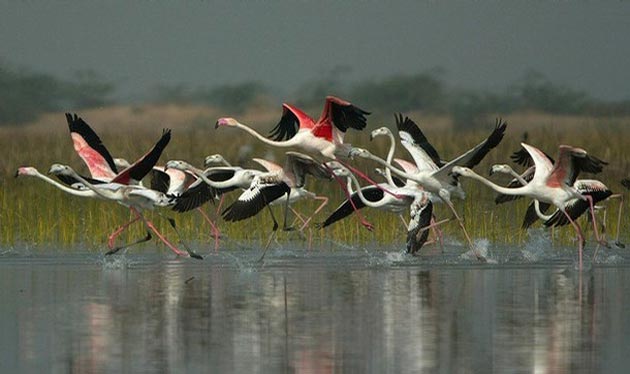
Srinagar: The Jammu and Kashmir government has launched demarcation of the Hokersar wetland, which was listed as a Ramsar site in 2005, and faced threats of encroachment and degradation of its environment.
Home to lakhs of migratory birds during winters, the 13.75 sq kilometre ‘queen of wetlands’ is located in Budgam district, 10 km from Srinagar, the summer capital of Jammu and Kashmir.
The UT government’s Revenue Department has set up a 16-member team of officials from multiple departments to demarcate the boundaries of the wetland and its adjacent Nambli-Narkara reserve.
A top revenue official under whose jurisdiction the wetland falls has asked the team to hold a field survey and clearly mark the boundaries of the wetland, which is among the protected ecological and biodiversity habitats, but faces threats of encroachment and mining.
Led by a Range Officer of the forest department, the team, comprising officials from revenue and forest departments, will submit its report to the Assistant Commissioner of Revenue in Budgam, for future protection of the wetland.
Officials said the demarcation exercise will include revenue record authentication, boundary verification, geo-referencing, demarcation of wetland areas, and removal of ambiguities in land ownership records to ensure the wetland is legally and physically protected from encroachments and unregulated activities.
The first demarcation of the wetland was carried out in 1935, and the same was notified in 1946. Social and environmental activists have alleged that encroachments and the situation have shrunk the wetland from 13 sq km to around 10 sq kms. Officials, however, deny encroachments and claim measures have been taken for its protection and conservation.
According to the Ramsar website, Hokersar, a natural perennial wetland contiguous to the Jhelum basin, is the only site with remaining reedbeds of Kashmir and pathway of 68 waterfowl species like Large Egret, Great Crested Grebe, Little Cormorant, Common Shelduck, Tufted Duck and endangered White-eyed Pochard, coming from Siberia, China, Central Asia, and Northern Europe.
The website describes the wetland as an important source of food, spawning ground and nursery for fish, besides offering feeding and breeding ground to a variety of water birds. Its typical marshy vegetation complexes inhabit Typha, Phragmites, Eleocharis, Trapa, and Nymphoides species, ranging from shallow water to open water aquatic flora.
It cites potential threats to the wetland, like encroachment by the construction of housing facilities, littered garbage, and demand for increasing tourist facilities.
A few years ago, the Jammu and Kashmir government constructed a water inlet system to retain the water level in the wetland for sustaining the migratory birds and other fauna and flora. However, the Environment Policy Group, a civil society group, recently flagged with the Jammu and Kashmir chief minister, Omar Abdullah, the withdrawal of water from the wetland for paddy cultivation and other issues facing the wetlands.
“Hokersar wetland is facing critical challenges despite huge sums of money having been spent on the construction of inlet and outlet gates to regulate the required water level. The wetland is experiencing severe restoration challenges that may compromise its ability to host migratory birds, potentially disrupting crucial ecological cycles. The wetland is experiencing illegal earth excavation, which will risk migratory birds’ habitat,” Faiz Bakshi, EPG convenor, said.
The group urged the Jammu and Kashmir government to take immediate action on the mismanagement and degradation of wetlands in Jammu and Kashmir.